
Views: 0 Author: Site Editor Publish Time: 2026-06-17 Origin: Site


Selecting an optical filter is rarely a simple catalog purchase. It stands as a critical system-level decision. This single component dictates your signal-to-noise ratio. It determines hardware accuracy. It ultimately decides your final application viability. You might design for dynamic machine vision environments. Perhaps you engineer analytical instrumentation or build aerospace optics. In any of these scenarios, choosing the wrong component introduces severe risks. Poor selection creates unwanted optical noise. It causes frustrating wavelength shifts. It can even lead to total mechanical failure under environmental stress. This guide provides a systematic, engineering-first framework to prevent these issues. We will help you evaluate and specify options accurately. You will learn to map out precise application requirements. We will explore hard technical parameters in depth. Finally, we address real-world field-implementation realities. You can use this knowledge to ensure long-term system stability.
Define the exact system requirements—specifically signal isolation and environmental stressors—before evaluating filter specifications.
Core technical parameters like Center Wavelength (CWL), Full Width at Half Maximum (FWHM), and Optical Density (OD) must be balanced against manufacturing tolerances.
Field failures often stem from overlooked variables, primarily Angle of Incidence (AOI) shifts and thermal drift.
The decision between off-the-shelf and a custom precision optical filter depends on prototyping speed versus long-term scalability.
You must establish clear parameters before looking at manufacturer catalogs. System requirements dictate the materials and technologies you will ultimately need. Skipping this step often leads to over-specification or complete system failure.
Identify your primary goal first. Do you need to maximize target signal transmission? Perhaps your main objective involves blocking specific ambient light. You might face intense LED interference. You could be dealing with stray laser scatter. Sometimes, the goal simply requires managing overall light intensity to protect sensitive detectors. Clearly outline these goals. This clarifies your required transmission and blocking thresholds early on.
Map out the exact operational environment. Indoor lab settings offer controlled conditions. Outdoor applications pose severe challenges. You must note dynamic or changing light conditions. This mapping proves crucial for outdoor machine vision or LiDAR systems. Sunlight introduces heavy broadband noise. Your system might face extreme temperature fluctuations. High humidity degrades certain materials. Always document these environmental baseline factors.
Determine your physical constraints next. Optics do not exist in a vacuum. They must fit inside physical housings. Calculate the maximum allowable thickness. Determine your weight budgets. Review the mounting mechanics inside your optical path. Thin substrates save space but warp easily. Heavy glass resists deformation but adds mass. Consider how mechanical stress from mounts might distort the glass. These physical parameters directly influence your final specification.
Various technologies address different optical challenges. You must select the right category before fine-tuning specific parameters. Each type handles light manipulation differently.
Evaluate these for highly selective applications. They isolate a specific spectral band. They block all surrounding wavelengths. You will frequently use them in fluorescence microscopy. Engineers also rely on them for laser line filtering. They maximize desired signals while eliminating background noise effectively.
Specify edge filters to separate distinct spectral regions. Longpass variants transmit longer wavelengths and block shorter ones. Shortpass variants do the exact opposite. You will often use them synergistically. They form the backbone of dichroic setups. They prove essential in Raman spectroscopy where separating excitation lines from emission signals is critical.
Select ND filters for broadband intensity reduction. They lower light levels evenly across the spectrum. They do not alter spectral distribution. This uniform attenuation prevents sensor saturation. You will need them when analyzing exceptionally bright light sources or testing sensitive camera sensors under harsh glare.
You must choose your underlying filtering mechanism carefully. Do you need high transmission and steep edges? Thin-film interference coatings deliver this performance. However, they remain highly sensitive to angle changes. Do you need angle-insensitivity and cost-effectiveness? Absorptive colored glass provides these benefits. Absorptive glass absorbs unwanted energy. Interference coatings reflect it away. Understanding this distinction prevents costly design errors.
Technology Comparison Chart: Interference vs. Absorptive | ||
Feature | Thin-Film Interference | Absorptive Glass |
|---|---|---|
Primary Mechanism | Reflects unwanted wavelengths | Absorbs unwanted wavelengths |
Edge Steepness | Extremely sharp | Gradual transition |
Angle of Incidence (AOI) | Highly sensitive (wavelength shifts) | Insensitive |
Cost Scale | Moderate to High | Low to Moderate |
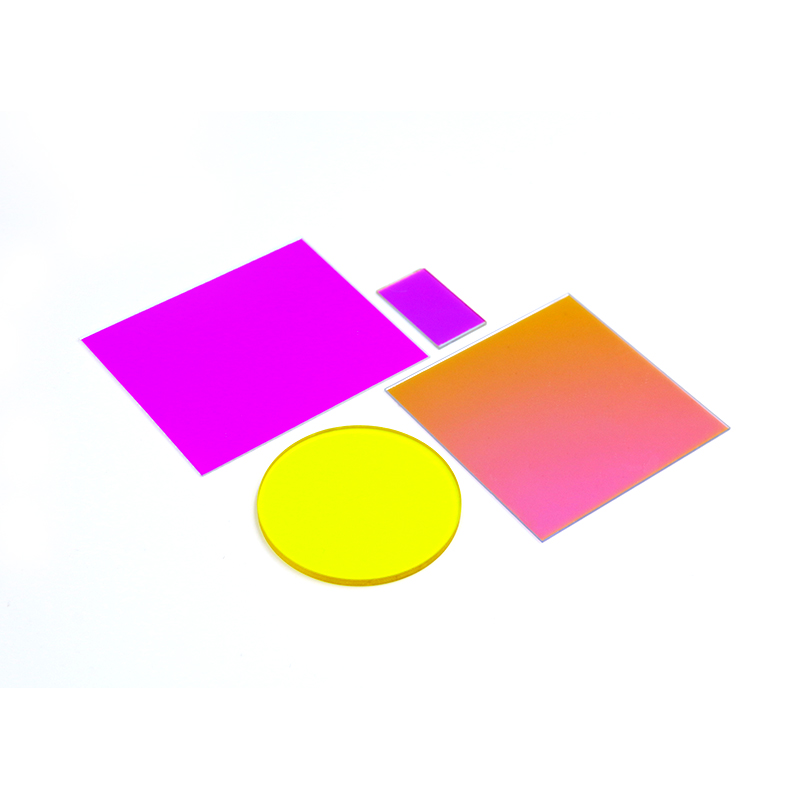
Specifying a Precision Optical Filter requires detailed numerical analysis. You must quantify your exact needs. Vague descriptions lead to underperforming components. Let us break down the critical metrics.
Calculate your required spectral positioning exactly. The Center Wavelength (CWL) defines the midpoint of your desired band. The Full Width at Half Maximum (FWHM) defines the bandwidth. Tighter FWHM values increase your isolation precision. However, this exponentially increases manufacturing complexity. Extremely narrow bands require hundreds of coating layers. This drives up production time and failure rates. Balance your need for precision against manufacturing realities.
You must balance what light passes through against what you block. Verify peak transmission (Tmax) guarantees within your passband. High Tmax ensures a strong signal. Next, assess your required out-of-band blocking. We measure this using Optical Density (OD). High OD values are vital for laser safety and high-sensitivity sensors.
OD 2: Blocks 99% of light (0.01 transmission). Suitable for basic contrast enhancement.
OD 4: Blocks 99.99% of light (0.0001 transmission). Necessary for most fluorescence applications.
OD 6: Blocks 99.9999% of light. Mandatory for laser safety and extreme sensor protection.
Your coating is only as good as its substrate. Evaluate Schott or Hoya glass variants for standard applications. Choose fused silica for ultraviolet requirements. Examine specialized substrates for their thermal expansion coefficients. You must also account for intrinsic transmission properties. The raw glass itself must not absorb your target wavelengths. Poor substrate choices ruin otherwise perfect coatings.
Surface defects scatter light. This degrades your final image. Specify strict tolerances based on component placement. Components placed near the focal plane require high quality. Use a 10-5 scratch-dig specification for these critical locations. Components placed further from the focal plane tolerate minor defects. You can safely use a 40-20 specification there. You must also consider laser damage threshold requirements. Powerful beams will destroy coatings at microscopic defect sites.
Perfect laboratory specifications often fail in the real world. Many engineers overlook dynamic variables during operation. You must proactively manage these implementation risks. Neglecting them guarantees compromised performance.
Light rarely hits your optics perfectly straight. You must account for off-axis rays. When the light path is not perfectly orthogonal (0° AOI), wavelength shifts occur. Thin-film interference components shift toward shorter wavelengths as the angle increases. Engineers call this phenomenon "blue shift". If you ignore this shift, your target signal will fall entirely outside the transmission band. Always calculate your maximum operational AOI.
Temperature changes physically alter materials. Model how heat variations affect your system. Temperature shifts change the refractive index of coating layers. They also cause substrates to expand or contract. This leads to measurable spectral shifting in extreme environments. Aerospace and outdoor applications face this risk daily. You might need specialized temperature-stable coatings. Hard-sputtered dielectric coatings resist thermal drift significantly better than older soft-coating technologies.
Systems rarely use perfectly collimated light. You often deal with converging or diverging light beams. Calculate the effect of these cone angles. High Numerical Aperture (NA) lenses create a wide range of AOIs simultaneously. This effectively broadens your passband. It also reduces your peak transmission. You must average these angles to predict actual system performance. Standard specifications assume collimated light, which misleads many designers.
Optics degrade over time. Humidity, abrasion, and thermal cycling destroy weak coatings. Audit your hard-coating specifications carefully. Compare them against MIL-STD or ISO requirements. Does your environment involve salt fog? Will technicians wipe the lenses frequently? Choose robust, ion-beam sputtered coatings for harsh environments. They resist moisture intrusion and physical abrasion far better than traditional evaporated layers.
Procurement strategy matters just as much as optical theory. You must decide how to source your components. The choice heavily influences your development timeline. Proper sourcing prevents massive engineering delays.
Do not order custom parts immediately. Utilize standard catalog options for early proof-of-concept work. This allows you to validate CWL and bandwidth assumptions rapidly. It remains highly cost-effective during initial testing. You can easily swap components if your initial calculations prove incorrect. Catalog parts keep early-stage R&D moving quickly. They prevent you from committing to untested designs.
Once you validate the design, transition strategies. Move to custom specifications for production. Customizing allows you to optimize specific form factors. You can integrate multiple elements into one substrate. This step is where Optical Filters achieve true system synergy. You can define proprietary spectral shapes unique to your application. This secures your intellectual property. It also ensures the components fit your exact mechanical constraints perfectly.
Not all optical manufacturers deliver equal quality. You must assess potential suppliers rigorously. Examine their metrology capabilities. Do they provide actual spectrophotometer trace data with every batch? You need proof of performance, not just marketing claims. Check their coating repeatability across different production runs. Request comprehensive compliance documentation. A reliable vendor acts as an engineering partner, not just a parts supplier.
Specifying precise optics requires deep technical balancing. You must weigh ideal spectral performance against harsh physical realities. Environmental factors like thermal dynamics and AOI shifts destroy poor designs rapidly. True engineering success demands a holistic, system-level approach from day one.
Compile a strict optical specification sheet before contacting vendors.
Detail your exact Center Wavelength (CWL) and out-of-band Optical Density (OD) requirements.
Map your maximum Angle of Incidence (AOI) and expected environmental tolerances clearly.
Consult with an experienced optical manufacturing partner early in your design process.
Take action now. Review your current system tolerances. Verify your optical path dynamics. Lock in these fundamental parameters today to ensure reliable, long-term system performance.
A: Interference filters use dielectric coatings to reflect unwanted light and offer precise, steep spectral edges. Absorption filters use doped glass to absorb unwanted light, offering lower precision but remaining unaffected by the angle of incidence.
A: Increasing the AOI on a thin-film interference filter causes the center wavelength to "blue-shift" (move to a shorter wavelength) and can distort the shape of the passband. You must account for this shift in non-collimated systems.
A: OD is a logarithmic measure of attenuation. OD 2 blocks 99% of light, OD 3 blocks 99.9%, and OD 4 blocks 99.99%. Higher OD is critical for applications involving lasers or highly sensitive detectors.
A: Yes, but stacking introduces multiple reflective surfaces that can cause ghosting, back-reflections, and overall transmission loss unless the filters are properly anti-reflection (AR) coated and optically integrated.


