
Views: 0 Author: Site Editor Publish Time: 2026-06-16 Origin: Site


Beyond basic wavelength manipulation, optical components act as critical gatekeepers. They determine the signal-to-noise ratio, accuracy, and overall reliability of complex electro-optical systems. Engineers depend on these components to parse useful data from chaotic light environments. Modern applications leave no room for error. Selecting the wrong profile or substrate material produces severe consequences. You might face rapid sensor saturation. Clinical settings could yield false diagnostics due to spectral bleed-through. Harsh field environments often cause outright system failures if thermal factors remain ignored.
This guide breaks down primary use cases and underlying technologies. We outline the strict evaluation criteria required to specify the right components. You will learn how to match specific spectral mechanisms to your operational environment. We will explore when catalog components suffice and when custom engineering becomes mandatory. By applying these principles, you can confidently integrate the precise components required for demanding OEM and enterprise-level applications.
Purpose: Optical filters exist to isolate desired wavelengths while aggressively blocking background noise, directly dictating system accuracy.
Applications: They are non-negotiable components in machine vision, fluorescence microscopy, LiDAR, and analytical spectroscopy.
Technology Choice: Choosing between absorptive and thin-film interference filters depends strictly on your requirements for precision (FWHM), durability, and thermal stability.
Sourcing: While off-the-shelf options suit early prototyping, scaling to production often requires a custom optical filter to meet specific Angle of Incidence (AOI) or environmental compliance standards.
Modern optical sensors are incredibly sensitive. They detect minute photon variations across broad spectral ranges. Without proper filtration, ambient light overwhelms the detector. Overlapping spectral bands confuse your analytical algorithms. Thermal noise further degrades the raw data stream. These interference sources quickly bury the target signal. This renders precise data extraction physically impossible. You must establish a clear optical boundary. Engineers face a constant battle between allowing useful light through and rejecting unwanted radiation.
A successful optical integration relies on two opposing success criteria. You must maximize target transmission to preserve your core signal. Simultaneously, you must maintain high Optical Density (OD) for all out-of-band wavelengths. High transmission ensures your sensors operate at maximum speed. High OD guarantees dark backgrounds and crisp contrast. Achieving both simultaneously requires precise engineering. You cannot evaluate a filter in isolation. Real-world implementation demands a comprehensive view of your entire optical architecture.
Evaluation must account for every element in the optical path. Light source emission spectra dictate what wavelengths enter the system. Sensor quantum efficiency determines how the detector responds to different colors. Environmental variables alter how components behave under stress.
Light Source Analysis: Map the exact emission curve of your LEDs or lasers.
Sensor Sensitivity: Align the passband with the peak quantum efficiency of your detector.
System Geometry: Calculate exact light angles hitting the optical surfaces.
You must map these variables before selecting any hardware. Ignoring the interplay between source, filter, and sensor guarantees suboptimal performance.
Industrial automation relies entirely on visual contrast. Cameras must detect microscopic defects on high-speed production lines. Factory lighting environments constantly change throughout the day. You cannot rely on ambient light for consistent quality control. Bandpass filters eliminate this variable lighting. They isolate specific LED illumination frequencies. For example, isolating 850nm infrared light creates stark contrast for surface defect detection. The sensor only sees the controlled LED pulse. It ignores overhead fluorescent lights, sunlight, and operator flashlights. This strict isolation enables reliable, continuous edge detection.
Clinical instruments demand extreme spectral precision. Fluorescence microscopy, flow cytometry, and DNA sequencing separate microscopic biological structures using light. Excitation lasers flood the sample with high-intensity energy. The biological markers emit a very weak fluorescent signal in response. You must separate these two paths. Extremely steep edge filters are mandatory here. Dichroic beamsplitters direct the laser toward the sample. Emission filters block the overwhelming scattered laser light. They allow only the faint fluorescent signal to reach the camera. High-performance Optical Filters prevent false-positive diagnostics by ensuring absolute spectral separation.
Remote sensing, range finding, and autonomous navigation rely on time-of-flight light measurements. LiDAR systems fire precise laser pulses across vast distances. They must capture the returning photons against a background of direct sunlight. Narrowband filters block the solar spectrum while transmitting the laser wavelength. Aerospace environments introduce extreme temperature fluctuations. Standard components experience center wavelength (CWL) drift when heated or cooled. Narrowband filters used in defense require strict thermal stability. Hard-sputtered coatings prevent the passband from shifting during rapid altitude changes. They guarantee consistent autonomous navigation in unpredictable climates.
Environmental monitoring and chemical analysis require precise compound identification. Molecules absorb and reflect light in unique patterns. Agriculture sensors measure crop health through specific spectral signatures. You must isolate these narrow signatures accurately. Analytical spectroscopy often uses longpass and shortpass filters in tandem. This creates a customized, highly specific passband. Sensors measure the exact concentration of target gases or soil nutrients. Unwanted spectral noise would skew the chemical analysis. Strict isolation guarantees regulatory compliance in environmental monitoring applications.
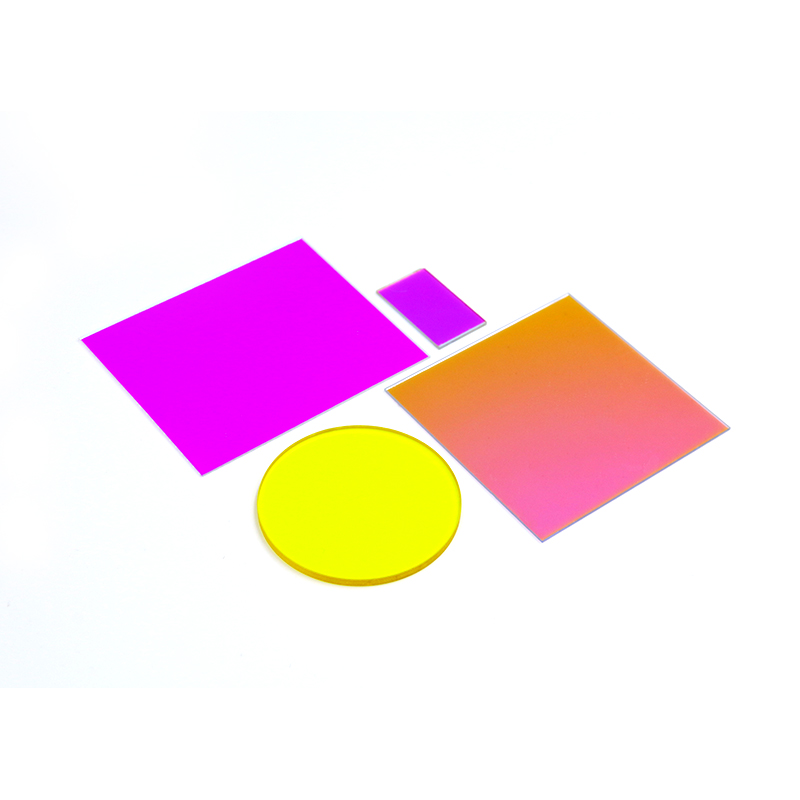
Selecting the correct technology mechanism directly dictates your system layout. Engineers must choose between absorption and interference. Each technology handles light physics differently. You must align the mechanism with your application constraints.
Absorptive filters use specialized glass compounds doped with specific elements. These dopants absorb unwanted wavelengths as light travels through the substrate. The absorbed photon energy converts into heat. They are highly predictable and cost-effective for broad spectral blocking. They remain largely angle-insensitive. You can tilt them without shifting the transmitted wavelengths. However, absorptive filters have distinct limitations. They cannot achieve highly steep transition edges. The transition from blocking to transmitting is gradual. Furthermore, they are prone to thermal damage. Because they absorb energy, high-power lasers easily heat and shatter the glass.
Interference filters utilize alternating microscopic layers of dielectric materials. Manufacturers deposit alternating high-index and low-index layers onto a substrate. These layers reflect unwanted light and transmit desired light via constructive interference. They do not absorb energy. Instead, they bounce rejected wavelengths away. This mechanism offers exceptionally high transmission rates. They produce near-vertical cut-on and cut-off edges. They achieve extreme OD blocking levels. However, interference coatings are highly sensitive to the Angle of Incidence (AOI). Tilting the filter alters the path length through the layers. This shifts the spectral curve toward shorter wavelengths, a phenomenon known as blueshifting.
The choice depends strictly on your precision requirements. If your application requires pinpoint accuracy, interference technologies are mandatory. Isolating a 2nm laser line requires microscopic dielectric layers. For general ambient light reduction, absorptive filters reduce overall system cost. They simplify mechanical mounting since angle variations do not degrade performance. Evaluate your thermal loads, required edge steepness, and budget constraints before committing to a technology.
Technology Type | Operating Mechanism | Primary Advantage | Primary Limitation | Ideal Application |
|---|---|---|---|---|
Absorptive Glass | Energy Absorption | Angle Insensitive | Gradual Edges, Thermal Stress | General Ambient Blocking |
Thin-Film Interference | Constructive Interference | Steep Edges, High Transmission | AOI Sensitive (Blueshifting) | Laser Isolation, Fluorescence |
Off-the-shelf catalogs offer thousands of standard wavelengths. Catalog components are ideal for proof-of-concept testing. They allow fast prototyping and rapid initial data collection. However, catalog components frequently fall short during commercialization. They rarely match the specific form factor required for proprietary instruments. Substrate thickness often conflicts with mechanical designs. Standard transmission curves rarely align perfectly with unique sensor architectures. Moving past the prototype stage usually demands custom engineering.
Transitioning from prototype to mass production introduces strict new constraints. You must adapt the component to your specific physical and environmental realities. Size and mounting present immediate challenges. Integration into micro-optics requires non-standard dicing and specific physical dimensions. Standard 1-inch rounds do not fit inside miniaturized medical probes. Custom sensor assemblies demand unique shapes to maximize space efficiency.
Environmental compliance forces further specialization. Standard coatings degrade quickly in the field. Military and aerospace applications require specific hard coatings. These coatings must withstand high humidity, extreme salt fog, and severe abrasion. Manufacturers test these against rigorous MIL-SPEC standards. If your device operates outdoors, a standard catalog coating will eventually fail.
Spectral fine-tuning becomes critical when dealing with variable light sources. Commercial laser diodes rarely emit at their exact specified wavelength. They also shift their output as operating temperatures rise. Adjusting the Center Wavelength (CWL) ensures peak transmission matches the real-world output of your specific laser. You cannot achieve this matched offset using off-the-shelf parts.
Partnering with a specialized manufacturer to engineer a Custom Optical Filter mitigates production risks. It ensures complete supply chain control. You guarantee lot-to-lot repeatability over multi-year production runs. Custom engineering ensures exact matching to your system's unique operational parameters. It removes the compromises forced by standard catalog limitations.
Engineers evaluate optical components using standard industry metrics. You must understand how these numbers interact. Optimizing one metric often forces compromises in another. Balancing these criteria dictates the final system performance.
CWL defines the exact midpoint of the transmitted light band. FWHM determines the total width of that transmission band, measured at 50% of peak transmission. A narrowband filter might have a CWL of 532nm and an FWHM of 10nm. This means it transmits light tightly around the 532nm mark. Specifying a very narrow FWHM requires exceptionally tight manufacturing tolerances. It increases production complexity. You must calculate the exact FWHM needed to isolate your signal without cutting off useful edge photons.
Optical Density serves as the logarithmic measure of blocking performance. It quantifies exactly how much unwanted light the coating rejects. Low OD numbers allow significant light through. High OD numbers block almost everything. An OD of 6 means only 0.0001% of unwanted light passes through the component. High OD is absolutely critical for laser safety and fluorescence applications. Weak blocking in these environments destroys detectors and risks human eye safety.
Optical Density (OD) | Transmission Percentage | Typical Use Case |
|---|---|---|
OD 1.0 | 10% Transmission | Basic light attenuation |
OD 2.0 | 1% Transmission | Standard machine vision |
OD 4.0 | 0.01% Transmission | Analytical spectroscopy |
OD 6.0 | 0.0001% Transmission | Laser blocking, fluorescence |
Transmission percentage measures the amount of desired light that successfully passes through the substrate. You want this number as close to 100% as possible. High-quality dielectric coatings routinely achieve 95% transmission in the passband. Poor transmission leads to severe downstream problems. It starves the detector of photons. This forces longer sensor exposure times. Longer exposures slow down overall system performance and reduce processing throughput.
AOI defines how the central light ray strikes the optical surface. Zero degrees AOI means light hits perfectly perpendicular to the glass. Tilting the glass changes the AOI. You must also account for Cone Angle. Light beams are rarely perfectly parallel. Converging or diverging light paths contain rays hitting the coating at varying angles simultaneously. Failing to account for this cone angle degrades expected performance. It widens the effective passband and reduces edge steepness. You must specify your exact beam geometry to the manufacturer.
Optical components are not merely passive accessories. They operate as the fundamental gatekeepers of all optical data. Their primary function solves the complex physics problem of signal-to-noise ratio in specialized environments. Without proper filtration, the most advanced sensors remain overwhelmed by ambient noise. Designing a successful optical path requires rigorous spectral management.
Evaluate the full environmental reality before specifying substrate materials.
Calculate exact required optical densities to protect sensors and isolate targets.
Map your source emission spectra against your detector's quantum efficiency.
Consult with a manufacturer early to determine if a catalog option suffices.
Specify custom parameters when packaging, thermal loads, or strict AOI geometry demand precision.
A: Using a thin-film interference component at an unintended angle causes "blue-shifting." The entire transmission band shifts toward shorter wavelengths. This misalignment pushes your target signal out of the passband, causing severe signal loss. Simultaneously, it allows unwanted noise into the detector. You must calculate and specify your exact AOI during the design phase.
A: Lifespan depends entirely on the manufacturing method and environment. Soft-coated options degrade quickly when exposed to high humidity and thermal stress. Conversely, hard-sputtered dielectric coatings offer extended longevity. They physically fuse materials at the molecular level. Hard coatings withstand harsh environments, abrasion, and intense laser energy, often lasting the entire lifetime of the instrument.
A: Several technical factors drive manufacturing costs. Extreme edge steepness requires depositing hundreds of individual microscopic coating layers. Substrate material choices, like fused silica versus N-BK7, alter raw material costs. Strict surface quality specifications, such as aggressive scratch-dig tolerances, decrease manufacturing yields. Finally, production volume dictates the amortization of initial engineering and tooling setups.


