
Views: 0 Author: Site Editor Publish Time: 2026-06-27 Origin: Site


Modern optical systems face a relentless and growing demand. Engineers must deliver unprecedented performance in increasingly compact form factors. Consumers and industries alike refuse to compromise on image quality. This intense pressure pushes traditional spherical lenses far past their physical limits. We need a definitive solution to correct spherical aberration while simultaneously shedding system weight. Historically, optical designers avoided these complex surfaces. They feared extreme manufacturing difficulty and high tooling costs. Today, advancements in fabrication have completely shifted this paradigm.
This guide is crafted specifically for optical engineers, product managers, and procurement teams. You likely need to evaluate advanced optics for next-generation devices. We will explore how size, weight, and power (SWaP) reductions justify the upfront investment. You will learn exactly when and where these advanced profiles make sense for your specific application. Our goal is to help you transition from theoretical designs to highly manufacturable, market-ready products.
Primary Benefit: Aspherical lenses solve spherical aberration with a single element, drastically reducing the size, weight, and complexity of optical assemblies.
Core Applications: Critical for precision imaging, laser targeting, LiDAR sensors, and advanced medical devices where edge-to-edge focal accuracy is non-negotiable.
Procurement Shift: Advancements in metrology and precision molding have made transitioning to a custom aspherical lens a viable, scalable strategy for proprietary OEM designs.
Evaluation Metric: The decision to upgrade hinges on balancing tight optical tolerances against manufacturing methodologies (e.g., CNC polishing vs. glass molding).
Standard spherical lenses have a fundamental physical limitation. Their constant surface radius causes light rays to behave inconsistently. Light entering the edges (marginal rays) bends more sharply than light entering the center (paraxial rays). They do not meet at a single focal point. Engineers call this phenomenon spherical aberration. You see it manifest as severe edge blur, ghosting, and optical distortion.
Historically, designers relied on a highly flawed traditional workaround. They stacked multiple spherical elements together to cancel out individual aberrations. This brute-force approach created severe downstream problems. Stacking three or four lenses introduced excess mass and consumed valuable internal volume. Every additional glass surface increased light loss through reflection. Furthermore, complex multi-lens barrels introduced mechanical vulnerability. A simple drop could misalign the entire delicate assembly.
We now turn to the modern solution. The complex, varying curvature of an aspheric surface profile corrects these aberrations natively. The surface flattens out toward the edges. This precise mathematical curve guides all light rays to a single, sharp focal point. By integrating Aspherical Lenses into an optical train, you can often replace three spherical components with just one element. The result is a dramatically lighter, brighter, and more robust system.
Common Mistake: Do not attempt to fix severe edge distortion merely by switching to a higher-index spherical glass. High-index spheres often introduce severe chromatic aberration, trapping you in an endless cycle of adding corrective elements.
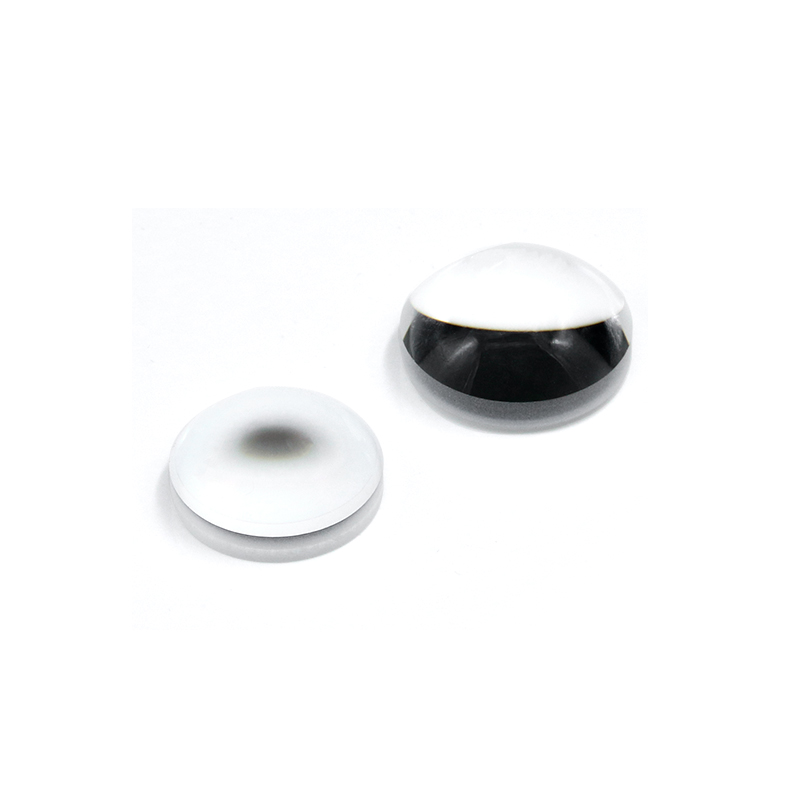
Advanced surface profiles unlock capabilities across diverse and demanding industries. When edge-to-edge focal accuracy is non-negotiable, standard spheres simply fail. Below are the core applications driving global demand for this technology.
Precision Imaging & Cinematography: Professional cameras require fast, wide-angle lenses. Broadcast systems must eliminate distortion without adding physical bulk. Aspheric profiles maintain brilliant high contrast and sharpness across the entire digital sensor plane.
Laser Optics & Photonics: Industrial lasers rely heavily on beam quality. Diode collimation and fiber coupling processes require precise energy focusing. Aspheres capture highly divergent laser outputs and align them perfectly, ensuring mission-critical efficiency.
Medical Devices & Ophthalmic Wear: Patient comfort drives innovation here. Corrective eyewear uses these profiles to create thinner, flatter lenses. This eliminates the dreaded "bug-eye" cosmetic effect. Surgeons rely on them for highly compact surgical endoscopes and precise intraocular implants.
Automotive LiDAR & Advanced Sensors: Autonomous vehicles operate in extreme, space-constrained environments. LiDAR systems spin rapidly to capture accurate depth data. Lighter optical payloads reduce motor strain and improve data fidelity at long ranges.
The following chart summarizes how different sectors prioritize specific optical advantages:
Industry | Primary Challenge | The Aspheric Advantage |
|---|---|---|
Imaging | Edge blur on large sensors | Perfect corner-to-corner sharpness |
Photonics | Laser divergence and energy loss | Optimal collimation in a tiny footprint |
Medical | Invasive device sizes | Miniaturization of endoscopic cameras |
Automotive | Heavy scanning payloads | Reduced mass for faster LiDAR rotation |
Transitioning away from legacy optics requires strategic justification. You must balance optical fidelity against unit cost. When does the expense of complex surface generation yield a disproportionate leap in product value? The answer lies in holistic system analysis.
First, consider the SWaP reductions. Size, Weight, and Power dictate success in modern engineering. Replacing a three-lens spherical assembly with one molded element drastically reduces payload weight. This metric is absolutely crucial for aerospace modules, consumer drones, and wearable technology. Less weight means motors consume less power. A smaller optical barrel allows you to design a sleeker, more competitive end product.
Material selection heavily influences this ROI calculation. You must evaluate substrates based on the intended operating environment. Each material dictates a different manufacturing approach and cost structure.
We typically categorize material environments as follows:
Standard Optical Glass: Ideal for precision imaging and visible light applications. It offers excellent transmission but requires specialized molding or polishing.
Germanium or Zinc Selenide (ZnSe): Mandatory for thermal and infrared (IR) applications. Defense and security systems rely on these expensive substrates, making part-count reduction highly profitable.
Optical Polymers: Perfect for high-volume, single-use items. Medical disposables and smartphone cameras utilize injection-molded plastics to achieve massive scale at a low unit cost.
Best Practice: Always calculate ROI at the assembly level. While an individual complex lens costs more than a simple sphere, eliminating two extra lenses, spacer rings, and assembly labor usually results in net savings.
Procurement teams face a critical fork in the road early in product development. Should you buy standard catalog components, or invest in bespoke designs? Your choice directly impacts scalability, lead times, and ultimate optical performance.
Standard catalog lenses serve a distinct purpose. They are readily available and cost-effective in low quantities. We highly recommend them for initial proof-of-concept prototyping. They also perform perfectly well in standard laser collimation setups where physical space is not tightly constrained. If your optical pathway allows for generic focal lengths, off-the-shelf is sufficient.
However, modern OEMs rarely operate in unconstrained environments. You will often encounter scenarios where standard components compromise product viability. A Custom Aspherical Lens becomes mandatory when navigating unique design hurdles.
Consider a custom approach if you face any of the following conditions:
Proprietary Sensor Sizes: Catalog lenses rarely match custom CMOS sensors perfectly, leading to light falloff or vignetting.
Highly Specific Focal Lengths: Precise magnification requirements often fall between standard catalog offerings.
Extreme Temperature Tolerances: Harsh environments dictate specialized glass types and custom athermalized designs.
Unique Mounting Constraints: Custom flanges, flat edges, or specific thicknesses ensure seamless mechanical integration.
Once you commit to a custom profile, you must match your design to the correct manufacturing method. Precision Glass Molding is best for high-volume scalability. It demands a high upfront tooling cost but delivers remarkably low unit costs at scale. Conversely, CNC Machining combined with Magnetorheological Finishing (MRF) requires no custom molds. This approach is best for low-volume, ultra-high-precision space applications or large-diameter elements.
Bringing advanced optics into production carries inherent risks. You must navigate complex metrology requirements and strict tolerancing rules. A brilliant theoretical design will fail entirely if your chosen manufacturing partner lacks specific capabilities.
The metrology challenge stands as the primary hurdle. A famous engineering adage applies perfectly here: "If you can't measure it, you can't make it." Standard optical comparators cannot verify a continuously changing curve. Buyers must ensure their supplier possesses advanced interferometry or profilometry equipment. This metrology gear must be specifically configured for non-spherical profiles. Ask for sample measurement reports during your vetting process.
Tolerancing pitfalls also trap many inexperienced engineers. We frequently see buyers over-tolerance their drawings. They copy tight specifications from legacy spherical prints and paste them onto new designs. Unnecessarily strict specifications on a complex curve exponentially inflate production costs. They slow down machine time and drastically lower production yield rates.
To mitigate these risks, prioritize Design-for-Manufacturability (DFM). We advise buyers to shortlist optical partners who offer robust DFM consulting. Engage them early in the CAD phase. Do not wait until you freeze the mechanical housing design. A skilled supplier will adjust inflection points and edge thicknesses slightly. This aligns your theoretical optical design with harsh manufacturing realities, ensuring a smooth transition to mass production.
The transition from legacy optics to advanced surface profiles represents a critical step for modern product development. While these complex lenses require a more rigorous design and manufacturing phase, the payoff is immense. You achieve unmatched optical clarity, eliminate heavy multi-element stacks, and drive aggressive system miniaturization.
Here are the crucial next steps for your team:
Evaluate your current optical assemblies for mass and light-loss inefficiencies.
Determine if standard catalog options can validate your initial proof-of-concept.
Transition to custom geometries when proprietary sensors or unique SWaP constraints demand tailored solutions.
Engage a metrology-focused manufacturing partner early to align your CAD models with production capabilities.
Do not let manufacturing hesitation compromise your next-generation product. We encourage engineering decision-makers to transition from theory to immediate feasibility. Submit your optical schematics for a comprehensive DFM review today. Contact a dedicated optical engineer to discuss custom fabrication timelines, material selection, and strategic scaling plans.
A: They carry higher initial NRE and tooling costs due to complex manufacturing and metrology. However, they frequently reduce overall assembly costs. By replacing three or four standard elements with a single advanced profile, you save money on raw materials, mechanical spacers, and intensive alignment labor.
A: No. It primarily corrects spherical aberration and significantly reduces coma and astigmatism. It does not natively correct chromatic aberration. Managing color fringing usually requires combining the element with specific optical glass types or creating an achromatic pairing within the system.
A: Lead times vary heavily by manufacturing method. CNC polishing and MRF finishing typically range from four to eight weeks for low-volume orders. Precision custom molded glass requires creating specialized tooling, which can push lead times to several months before first-article delivery.
A: Yes. Optical-grade polymers like polycarbonate and Zeonex are routinely used. Manufacturers injection-mold these plastics for high-volume, cost-sensitive applications. You will find molded polymer elements inside virtually every modern smartphone camera, VR headset, and disposable medical endoscope on the market.


