
Views: 0 Author: Site Editor Publish Time: 2026-11-04 Origin: Site


Modern laser systems demand absolute precision. From high-powered industrial cutters slicing through thick steel plate to delicate medical devices performing cellular-level surgery, controlling light output remains a fundamental engineering necessity. Traditional spherical optics focus light into a single, concentrated spot. However, modern automated applications demand a completely different approach to beam management. This is exactly where the Cylindrical Lens becomes an essential component.
Unlike their spherical counterparts, these specialized optics manipulate light in a single dimension. By focusing or expanding a laser beam along one specific axis, they give engineers unique control over the laser footprint. Are you an optical engineer designing a new alignment tool or a procurement specialist sourcing high-damage-threshold parts? Understanding these components ensures you make informed optical choices.
These specific lenses are essential for manipulating laser light in one dimension, focusing it into a line rather than a single point.
Beam shaping serves as their most common application, particularly in correcting the elliptical output of standard laser diodes into perfectly circular beams.
They represent the standard optical solution for generating a precise reference line used in machine vision, 3D scanning, and industrial alignment tools.
Depending on the specific application, systems will utilize either a concave or convex profile to diverge or converge the laser beam.
Choosing the right optic requires careful consideration of focal length, substrate material, and anti-reflective coatings to maximize laser system efficiency.
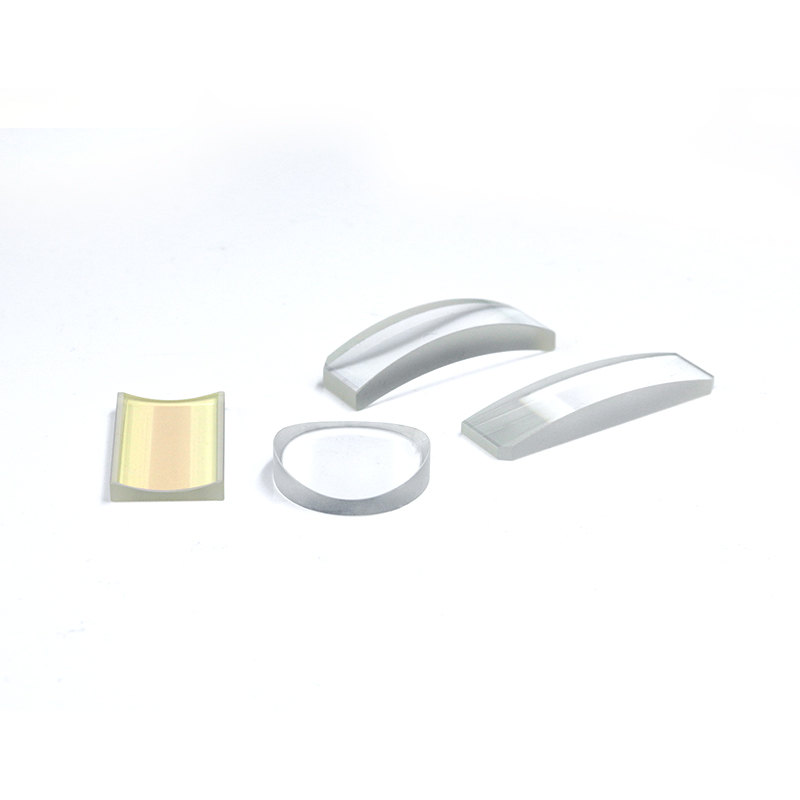
To fully grasp their application, we must first look at the optical mechanics. Standard lenses are symmetrical. They curve along both the X and Y axes, meaning light passing through them converges to a single point. In stark contrast, a cylindrical optic features one flat surface and one curved surface resembling a section of a cylinder.
Because the curvature exists on only one axis, the lens bends light exclusively in that specific dimension. Light traveling parallel to the flat axis passes through without distortion. Meanwhile, light hitting the curved axis alters its path. This unique geometric design forces the light into a one-dimensional line rather than a solitary point.
Within laser setups, engineers primarily rely on two configurations. Each serves a distinct operational purpose.
A convex profile features a flat side and an outward-curving side. It converges incoming parallel light rays, focusing them into a sharp line at a specific focal distance. This behavior proves highly useful for concentrating light into a narrow slit detector.
Conversely, a Plano Concave lens incorporates a flat side and an inward-curving side. This design diverges light along a single axis. Instead of focusing the beam, it expands it in one dimension. Such expansion is particularly valuable when projecting a spreading light source across a large industrial workspace.
In the highly technical field of photonics, Beam Shaping acts as a foundational process. Many raw laser sources fail to naturally produce the perfectly symmetrical, circular beam that engineers desire. Without deliberate optical correction, these raw lasers remain inefficient for high-precision tasks.
Standard laser diodes boast incredible electrical efficiency. Yet, their natural emission profile remains inherently problematic. Due to the rectangular geometry of the diode active semiconductor area, the resulting beam emerges highly elliptical. It diverges rapidly on the fast axis and sluggishly on the slow axis.
To rectify this asymmetry, optical designers deploy specific cylindrical components. By placing a crossed pair of these optics directly into the optical path, the beam can be magnified along the slow axis or collimated along the fast axis. This precise adjustment transforms the skewed output into a perfectly circular beam ready for efficient fiber optic transmission.
Beyond basic circularization, analytical instruments rely heavily on beam formatting. In sophisticated spectroscopy equipment, a laser must frequently funnel into a narrow linear detector. By utilizing a one-dimensional optic, the entire energy profile of a circular laser beam compresses into a straight line. This straight line perfectly matches the exact dimensions of the entry slit, ensuring maximum light throughput while actively preventing signal degradation.
One of the most visually recognizable applications of these optics lies in generating a crisp, straight Laser Line. When a collimated beam passes through the curved surface, it stretches along a single axis, casting a uniform and intense line of light onto a target.
Recent market analyses indicate a massive surge in automated machine vision and miniaturized 3D scanning systems. Driven by the rapid expansion of electric vehicle manufacturing and advanced semiconductor inspection, the demand for robust one-dimensional optical manipulation has skyrocketed. As global manufacturing scales, industrial laser systems must function flawlessly in harsh, high-vibration environments. This accelerating trend forces engineers to pivot toward customized cylindrical solutions that deliver sub-micron accuracy without succumbing to thermal degradation.
In practice, a machine vision system projects a continuous line of light onto an object speeding down a conveyor belt. High-speed cameras capture the geometric variations of the line as it distorts over the object surface topology. Advanced software algorithms then construct a highly accurate 3D profile in real-time. This non-contact measurement technique proves vital for inspecting everything from automotive parts to printed circuit boards.
On a more macroscopic scale, these lenses serve as the core functional components in industrial alignment tools. Traditional construction laser levels utilize specialized optics to project a perfectly straight, intensely bright reference line across uneven terrain. Similarly, industrial targeting systems in sawmills rely on this visual guide to ensure operators make accurate cuts, drastically reducing material waste.
While circularizing a beam addresses its physical footprint, edge-emitting diodes suffer from another inherent optical flaw demanding immediate correction. That flaw is astigmatism.
In a standard edge-emitting semiconductor, the physical origin of the beam differs slightly for the vertical and horizontal planes. Because the light diverges at different angles, the beam essentially generates two distinct focal points. If an engineer attempts to focus an astigmatic laser using a standard spherical optic, they will never achieve a perfectly sharp spot. One axis will inevitably remain blurry while the other appears sharp.
To resolve this frustrating divergence, optical designers strategically introduce a precisely calculated cylindrical component. Since this optic only interacts with light in one dimension, it can be rotationally aligned to shift the focal point of just the lagging axis. By applying the exact amount of convergence needed, the focal point of one axis moves forward until it aligns with the other. This targeted alignment eliminates the astigmatism, yielding a clean and tightly focused output.
Theoretical mechanics translate directly into groundbreaking applications across high-stakes industries. This bridges the gap between raw physics and practical commercial utility.
Within the medical sector, absolute precision remains non-negotiable. Ophthalmic laser systems incorporate high-precision optics to meticulously shape the excimer laser beam used during refractive surgeries. By matching the optical profile to the specific corneal irregularity of the patient, the system ablates microscopic layers of tissue with flawless accuracy.
Shifting to heavy manufacturing, high-power lasers routinely handle cutting, welding, and surface treatment. Slicing through thick steel requires a tightly pinpointed focus. However, processes like laser annealing or wide-seam welding demand a broader approach. By formatting a high-power laser into a linear profile, manufacturers can apply intense heat over a wide area simultaneously in a single pass. This linear heat distribution significantly increases processing speeds and improves assembly line throughput.
Beyond heavy industry and surgical medicine, manipulating light in a single dimension unlocks advanced data processing capabilities.
In the complex realm of optical data storage, controlling the phase and amplitude of light is paramount. Engineers frequently use these optics to stretch and format reference beams, enabling systems to read or write dense data across optical media. This one-dimensional manipulation helps create the highly controlled interference patterns required to record three-dimensional holographic images accurately.
Spectrometers analyze the spectral properties of light to determine chemical compositions. To achieve maximum resolution, incoming light must enter through a very narrow entrance slit. If a raw circular beam shines directly at this opening, the surrounding casing blocks the majority of the energy. By placing a Plano Convex lens directly in front of the slit, the circular beam compresses into a bright, concentrated line. This specific configuration maximizes light throughput, drastically improving the signal-to-noise ratio.
Selecting the appropriate optical components represents a critical step in system design. Engineers must evaluate several technical parameters to ensure optimal performance, efficiency, and longevity. To simplify this process, we have outlined the core selection criteria below.
Application Type | Recommended Substrate | Surface Quality | Typical Anti-Reflective Coating | Key Benefit |
|---|---|---|---|---|
Visible Light / Low Power | N-BK7 Glass | 40-20 Scratch-Dig | Broadband 400-700 nanometers | Cost-effective, excellent visible transmission. |
High-Power Industrial / Ultraviolet | UV Fused Silica | 20-10 Scratch-Dig | V-Coat 1064 or 355 nanometers | High laser damage threshold, extreme thermal stability. |
Near-Infrared Telecom | N-BK7 or Fused Silica | 40-20 Scratch-Dig | Broadband 1050-1620 nanometers | Optimized for fiber optic coupling and low insertion loss. |
The choice of substrate material depends heavily on operating power and specific wavelength. For visible light applications, N-BK7 glass stands out as a highly cost-effective choice. Conversely, high-power industrial lasers strictly require UV Fused Silica. This premium material offers lower thermal expansion and higher laser damage thresholds, preventing the optic from shattering under intense stress.
Bare optical glass naturally reflects a portion of the light striking its surface. This leads to significant power loss and dangerous back-reflections. Applying a wavelength-specific Anti-Reflective coating mitigates this issue. Proper coatings ensure nearly complete transmission of laser energy, protecting the sensitive laser diode from feedback damage.
In high-power environments, microscopic imperfections trigger beam distortion or localized heating. Specifications such as surface figure and scratch-dig ratios must undergo strict evaluation. Standard commercial applications might accept a 60-40 scratch-dig, but precision laser systems demand 40-20 or even 20-10 quality. Finding a reliable supplier capable of delivering flawless optical components ensures complete system compatibility.
Cylindrical lenses stand as indispensable components in modern optical engineering. They act as the primary tools for shaping beams, generating precise reference lines, and correcting inherent diode astigmatism. Whether your specific system design requires a concave profile to diverge light or a convex profile to focus it, mastering these one-dimensional optical properties remains key to successful engineering.
For engineers and procurement managers looking to optimize their laser systems, partnering with a trusted manufacturer is crucial. We highly encourage you to explore the extensive catalog at Rising-EO to specify and source the exact high-precision optical components your project demands.
A spherical lens features a symmetrical, uniform curvature that focuses incoming light into a single point. In contrast, a cylindrical optic has one flat surface and one curved surface. This unique geometry focuses or expands light along a single axis, creating a one-dimensional line.
Yes, but it functions differently than a convex optic. It diverges the beam in one dimension, creating a continuously spreading line. A convex optic, on the other hand, converges the light into a sharp, intense line at a fixed focal distance.
Laser diodes naturally emit an asymmetrical, elliptical beam due to their physical semiconductor architecture. Optical shaping corrects this uneven divergence, transforming the irregular oval output into a highly usable, circular beam required for precision focusing.
The correct Anti-Reflective coating depends entirely on your operating wavelength. You must select a coating designed specifically for the exact nanometer range of your system. Matching the coating to the wavelength minimizes surface reflection and maximizes energy transmission.
The laser damage threshold depends on both the substrate material and the applied coating. Standard N-BK7 glass with a broadband anti-reflective coating generally handles low to medium continuous-wave power. For pulsed, high-peak-power industrial systems, UV Fused Silica with a specialized V-coat can withstand significantly higher energy densities.
The focal length directly determines the convergence angle of the beam. A shorter focal length creates a much thinner, more intensely focused line at a closer working distance, but the depth of field will be shallow. A longer focal length produces a slightly thicker line that maintains its focus over a much longer working distance, which is ideal for large-scale alignment tools.


