
Views: 0 Author: Site Editor Publish Time: 2026-06-15 Origin: Site


While Aspherical Lenses eliminate spherical aberration and reduce overall optical assembly weight, their complex surface profiles introduce significant manufacturing and metrology challenges. You cannot simply batch-polish these varying curvature components using traditional lapping plates. For optical engineers and procurement teams, selecting the right manufacturing process is not just a technical decision. It heavily dictates tooling costs, lead times, and long-term scalability. Getting this choice wrong can delay a critical product launch by several months. Worse, it might lock your team into an unscalable supply chain. This guide breaks down the core manufacturing methodologies, metrology requirements, and scale considerations to help you properly evaluate vendors. You will learn how to transition seamlessly from a single prototype to volume production. We will help you choose the right production path for your custom optics, ensuring high precision while managing your engineering budgets effectively.
Manufacturing methods for custom aspheres range from deterministic CNC polishing for low-volume prototypes to glass molding for high-volume production.
Tooling costs and Non-Recurring Engineering (NRE) fees heavily dictate the break-even point for transitioning a custom prototype to a precision molded lens.
Metrology (testing and validation) is often the bottleneck in asphere production; vendor capabilities in sub-aperture stitching or Computer-Generated Holograms (CGH) are critical evaluation criteria.
Material selection—especially between IR materials, standard optical glasses, and optical polymers—directly restricts which manufacturing methods are viable.
The baseline problem in optical manufacturing originates from geometry. Spherical lenses form naturally through uniform lapping and polishing. A polishing tool naturally grinds a piece of glass into a perfect sphere. You can process dozens of spherical elements simultaneously in large batches. In contrast, an aspheric profile requires localized, deterministic material removal or highly engineered molds. Because the radius of curvature changes constantly across the lens diameter, traditional batch processing fails entirely. This fundamental geometric difference creates an immediate challenge for production scalability.
You must navigate a direct matrix tradeoff between upfront investment and per-unit cost. Highlighting this tradeoff clarifies your budgeting strategy. If you choose mold creation and extensive process engineering, you pay a steep initial price. Developing a precision mold requires expensive tungsten carbide materials and weeks of engineering time. However, this dramatically lowers your per-unit cost at mass scale. If you choose direct deterministic machining, you skip the heavy upfront tooling fees entirely. Yet, your individual part costs remain stubbornly high due to long machine cycle times.
A major structural risk lies in the prototyping-to-production gap. The reality is simple. The method you use to prototype your custom lens will likely differ from the method you use to scale it. Optical engineers often prototype using multi-axis CNC grinding to avoid tooling costs for five units. Later, procurement teams demand a transition to glass molding for mass production. This shift necessitates a design robust enough to survive both manufacturing processes. Small design tweaks required during this transition can trigger unexpected optical performance shifts. You must plan for this gap on day one of the design phase.
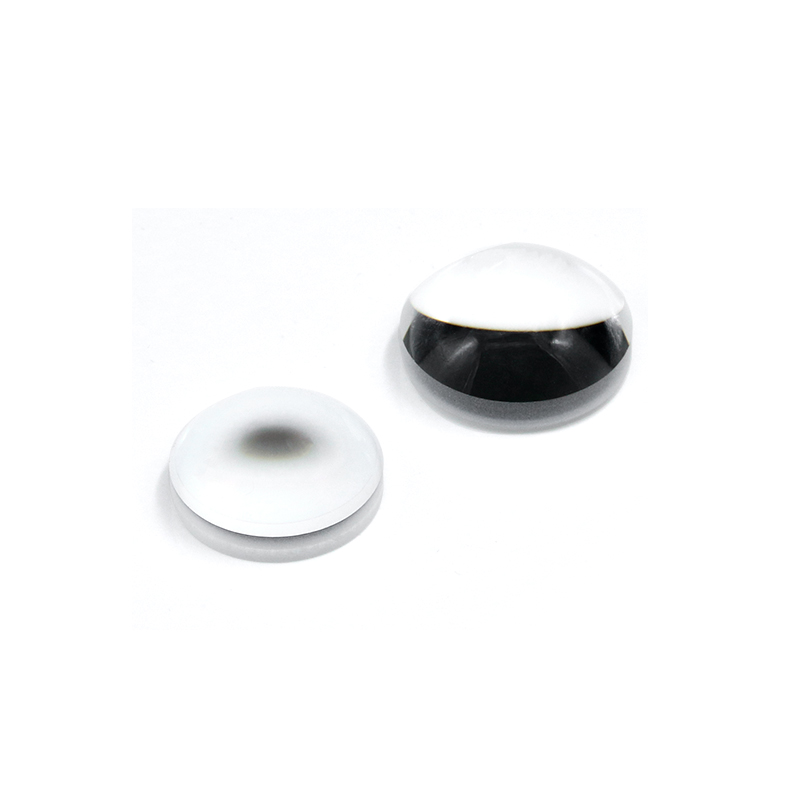
Different manufacturing methods suit vastly different volumes, materials, and precision levels. Understanding the mechanics behind each technique helps you match the process to your optical requirements. Here is a breakdown of the primary processes you will encounter in the field.
Sub-aperture polishing and Magnetorheological Finishing (MRF) dynamically adjust material removal. The machine utilizes a highly controlled fluid or small physical tool. It responds directly to the lens's exact position and a pre-measured surface error map. As the tool moves across the glass, it corrects minute topological errors point-by-point.
Best For: Low-to-medium volumes, large-diameter lenses, rapid prototyping, and extreme precision requirements. Space and defense applications rely heavily on this method.
Tradeoffs: Slower cycle times inevitably drive up the per-unit cost. Polishing a single large lens can take many hours. However, you face minimal upfront tooling requirements compared to molding techniques.
This method involves heating optical glass to its exact softening point inside a highly controlled thermal chamber. A machine then presses the softened glass into a highly precise, durable mold. The glass takes on the inverse shape of the mold cavity.
Best For: Medium-to-high volume production where consistency is absolutely critical. It produces a highly repeatable precision molded lens across tens of thousands of units.
Tradeoffs: You must absorb high upfront tooling costs and non-recurring engineering (NRE) fees. The process is strictly limited to specific moldable glass types featuring appropriate transition temperatures. Furthermore, mold degradation over time requires periodic replacement investments.
Manufacturers use an ultra-precise diamond-tipped lathe to physically cut the aspheric profile directly into the substrate. The machine rotates the part rapidly while a finely controlled diamond tool sweeps across the surface.
Best For: Infrared (IR) materials like Germanium or Zinc Selenide, optical polymers, and metal mirrors. Thermal imaging systems depend entirely on SPDT technology.
Tradeoffs: You cannot use SPDT for standard silica or conventional glass. The tool wear is simply too rapid and destructive. Furthermore, the turning process leaves distinct tooling marks. These micro-grooves require post-polishing if you intend to use the lens for visible-light applications.
This technique utilizes standard plastic injection principles optimized for optical purity. Machines inject molten optical-grade plastics into a polished aspheric cavity under extreme pressure. Common optical materials include PMMA, Zeonex, or Polycarbonate.
Best For: Ultra-high volume, low-weight, cost-sensitive commercial applications. Virtual reality headsets and smartphone cameras utilize this method extensively.
Tradeoffs: Polymers naturally offer lower thermal and environmental stability than glass. They degrade under high heat or intense UV exposure. You also need strict tooling tolerances to carefully manage polymer shrinkage as the part cools inside the mold.
Manufacturing Methods Volume & Material Matrix Chart | |||
Manufacturing Method | Ideal Volume Range | Material Compatibility | Relative Tooling Investment |
|---|---|---|---|
CNC Polishing / MRF | 1 - 500 units | Standard Glass, Fused Silica | Low |
Precision Glass Molding | 1,000+ units | Moldable Glass (Low Tg types) | Very High |
Diamond Turning (SPDT) | 1 - 1,000+ units | IR Materials, Polymers, Metals | Low - Medium |
Injection Molding | 10,000+ units | Optical Polymers (PMMA, Zeonex) | High |
Your specific optical design directly dictates the viability of any given manufacturing process. Even microscopic geometry changes can drastically alter production difficulty and inflate your budget.
Engineers must carefully watch for severe curvature changes. Profiles featuring "gull-wing" shapes or sudden drop-offs introduce steep inflection points. These complex curves drastically increase manufacturing time. They also complicate metrology efforts. A physical polishing tool naturally struggles to conform to a sudden reverse curve on the glass. Consequently, the tool leaves mid-spatial frequency errors across the transition zone. Avoid designing sharp inflection points whenever optical performance allows.
Material selection restricts your fabrication options even further. You must deliberately match the required refractive index and Abbe number to the specific manufacturing capability. For example, if you plan to scale up to millions of commercial units, you should standardize on moldable glasses like D-ZK3 or D-LAK6. These low-transition-temperature materials optimize volume efficiency inside thermal presses. Conversely, if your design relies on a ruggedized glass possessing a high transition temperature, you cannot mold it. You will remain locked into slower, more expensive CNC grinding methods.
You also need to critically balance surface roughness against form error. Tightly defining acceptable tolerances prevents unnecessary manufacturing expenses. High form accuracy, measured in PV or RMS, matters heavily for precise wavefront performance. Cosmetic surface roughness primarily impacts light scatter and laser damage thresholds. Balancing these two distinct requirements helps you avoid dangerous over-speccing. Over-speccing a non-critical surface parameter will needlessly drive up your testing and fabrication costs.
A manufacturer can only reliably produce an asphere as accurately as they can actually measure it. Metrology acts as the ultimate unyielding gatekeeper for product quality. Relying on outdated testing methods leads directly to sub-par system performance.
When auditing a new manufacturing partner, you must rigorously question their testing capabilities. Look specifically for these key metrology equipment setups:
Contact profilometry: This mechanical measurement is essential for determining gross shape accuracy during the initial rough grinding phases.
Interferometry combined with Null Lenses or CGHs: Traditional interferometers only test spheres easily. Validating an aspheric surface requires a Null Lens or a Computer-Generated Hologram (CGH) to pre-distort the wavefront. This provides final validation of the complex surface.
Stitching interferometry: This technique is highly critical for inspecting high numerical aperture (NA) lenses. A single sub-aperture measurement cannot capture the entire steep surface. The machine must stitch multiple smaller interferograms together mathematically.
For demanding sectors like defense, aerospace, or implantable medical devices, you must also evaluate organizational compliance. Check the vendor's updated ISO certifications, such as ISO 9001 for quality management and ISO 13485 for medical devices. If your project involves defense technologies, verify their active ITAR registration status immediately. Assess their internal documentation practices thoroughly. Can they smoothly provide complete material lot traceability? Strong metrology matched tightly with rigorous compliance documentation ensures your complex optics perform reliably in demanding field environments.
Transitioning from a theoretical software design to a tangible finished component carries heavy financial and timeline risks. Anticipating and understanding these common pitfalls allows you to mitigate them early in the procurement cycle.
First, explicitly define who actually owns the mold or tooling after you pay the NRE fees. A painful tooling shock occurs when a client attempts to switch vendors due to poor quality. They suddenly discover they do not own the custom mold they financed. Always assume a realistic minimum viable quantity before committing to expensive molding. Calculate your precise break-even point to ensure the volume justifies the initial NRE.
Lead time realities often severely surprise unprepared procurement teams. Creating custom molds for precision glass molding is not a rapid process. It can easily take 8 to 12 weeks before a vendor produces a valid first-article component. You can creatively mitigate this dangerous delay. Run parallel CNC prototypes to physically test the optical system alignment while the factory machines the complex steel mold.
You must deeply account for thermal expansion nuances during any molding operation. Glass physically shrinks during the cooling phase inside the press. Experienced vendors handle this proprietary tool offset calculation internally using advanced software. However, it requires thorough design-for-manufacturability (DFM) reviews. A minor miscalculation in assumed shrinkage behavior inevitably leads to a massive rejected batch of deformed lenses.
Best Practice: Schedule an early DFM review before freezing your Zemax or CodeV design files.
Common Mistake: Failing to secure legal tooling ownership in the initial contract terms.
Common Mistake: Assuming the CNC prototype glass behaves thermally identically to the mass-production moldable glass equivalent.
Selecting the right methodology requires a highly logical evaluation of projected volume, chosen material, and target spectrum. Use these specific strategic guidelines to shortlist your best production path.
If Volume is under 500 and Material is Glass: Default immediately to CNC Grinding and MRF. The complete lack of tooling fees makes this the most economical route for small development batches. You pay more per lens, but you save tens of thousands in upfront engineering.
If Volume is over 1,000 and Material is Glass: Investigate Precision Glass Molding thoroughly. The high NRE amortizes cleanly across the elevated unit count. This yields a vastly cheaper per-part price and guarantees better part-to-part consistency.
If Spectrum is LWIR or MWIR: Single-Point Diamond Turning is highly likely the required path. Infrared materials like Germanium, Chalcogenides, and Zinc Selenide cut exceptionally cleanly on a diamond lathe. You cannot easily mold these specific substrates.
For your immediate next steps, firmly request a comprehensive DFM (Design for Manufacturability) review before finalizing any optical tolerances. Provide your shortlisted vendors with realistic operating environment data. Do not just hand over a simple optical prescription. Knowing extreme thermal constraints or shock requirements helps them proactively select the best manufacturing process for your specific field application.
Successfully navigating custom optical production requires carefully aligning your realistic volume expectations, precise material needs, and budget constraints to the correct methodology. Every production path carries distinct tooling and lead-time realities. You might opt for CNC polishing to secure high-precision prototypes. Alternatively, you might heavily invest in glass molding to achieve massive scale. Your strategy dictates your long-term success.
Keep these final actionable steps in mind:
Conduct a rigorous DFM review early in the design cycle. This prevents designing un-manufacturable geometries that contain severe inflection points.
Map your production volume projections accurately. This action determines the exact break-even point for heavy mold investments.
Verify your vendor's specific metrology capabilities. If they cannot actively measure the surface using CGHs or stitching interferometry, they absolutely cannot guarantee your specification.
Secure all tooling ownership terms upfront in the contract to prevent future supply chain lock-in.
Procuring custom aspheres requires building a true engineering partnership. It is never just a simple purchase order. Early engagement with a competent manufacturer's DFM team prevents disastrous over-speccing. This proactive collaboration guarantees scalable, cost-effective production for your advanced optical systems.
A: The timeline splits into tooling creation and actual production. Custom mold design and fabrication typically take 8 to 12 weeks. Once the vendor completes the mold and validates the first article, actual production runs are fast. Depending on volume, you can expect mass-produced units in an additional 4 to 6 weeks.
A: Spherical lenses allow for batch processing using uniform polishing motions. Aspheres require deterministic, serialized processing. Machining an asphere means removing material point-by-point to create a varying curvature. Furthermore, verifying an asphere requires highly specialized, expensive metrology equipment like CGH interferometers, which adds to the final unit cost.
A: No. Switching requires a design revision. You often have to change the glass type to a low-transition-temperature variant suitable for molding. The vendor must also recalculate mold shrinkage offsets based on the new material's thermal properties. These adjustments alter the original optical prescription and require careful re-optimization.
A: Realistic constraints depend on the manufacturing method. CNC grinding and MRF can handle large diameters, often exceeding 200mm. Conversely, glass molding is typically restricted to diameters under 50mm. This size limit exists because press mechanisms and thermal gradients become too difficult to control in larger molds.


